Settings are not influential on results 2,2,90,0.01,0.01…
There is a storm going on here,but in the last few days I tried with only Galileo $PQTMCFGCNST,W,0,0,1,0,0,0*2A
I noticed that the HAS system needs at least 8 valid satellite PRNs even if each individual satellite broadcast the corrections; getting into the PPP algorithm would be interesting if only they told us how to interpret the raw data spat out by $PQTMCFGMSGRATE,W,1,1,0AE6,1,1*54
P.s. in the 1980s I was struck by an academic article that indicated at least thirty (30!) parameters that influenced a GPS solution…
Hi @bamarcant
In my country, 8 Galileo satellites is almost the maximum we can see.
So that could be a problem.
These days the geomagnetic Kp index is very low.
It would seem that the differences between yesterday and today in my area are not due to atmospheric problems.
We will continue analyzing.
That’s always going to be the situation for any GNSS device. It never knows the true location to calculate accuracy…and never will. The “10cm reported accuracy” is just an educated guess. It’s basically an estimate based on how well the current solution aligns with recent epochs, nothing magical
Solar Activity (worth it’s own Thread):
I look at 2 main sources when using GNSS, but especially when testing.
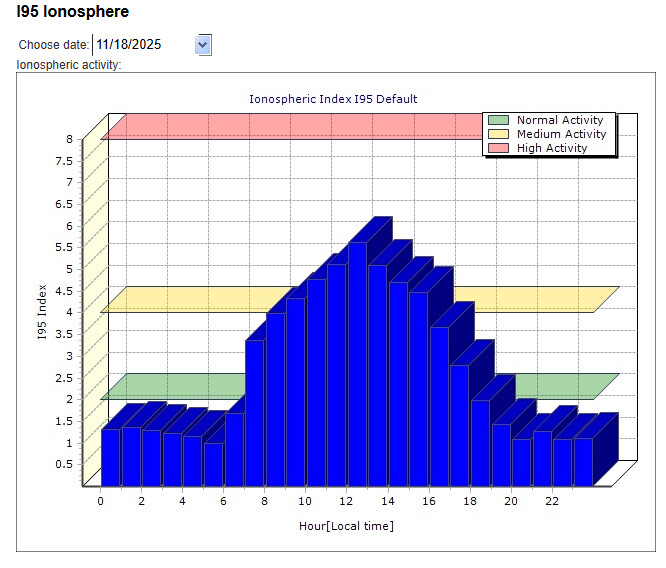
I95 Ionosphere -
But the best source for me is our StateWide CORS network. That network reports the I95 Index, local. If you can find a local I95 Index, it can sometimes give you a good answer when positions start bouncing around, or when a receiver takes longer for RTK Fixed solution, etc.
With earlier PPP firmware on the LG290P I was seeing 95% horizontal accuracy values in the 30 to 40 cm range. for 24 hour datasets. I’ve only done the one test with the latest firmware and that’s shown above with a value in the low 20 cm range.
I’m not spending a lot of time on it since it’s still beta, but there seems to be progress on Quectel’s end. If Galileo adds phase biases soon that will help too.
Quectel has given me another beta release (attached) “LG290P03AANR01A06S_PPP_TEMP1107.zip”. Also posted to the repo. There are no release notes so it’s not clear to me what has changed. I have not yet had a chance to try it. Please let me know if you test it and what you experience.
Hi @Sparky
Thank you so much for your continued support.
This is the version that Quectel sent to @bamarcant and me a few days ago, which was shared in the messages above.
It was after much persistence, as they were reluctant to share beta versions.
The most noticeable difference is that the PPP results with Galileo HAS are much better than before.
This is quite similar to a near-final version with respect to Galileo HAS.
We’ll stay in touch and are waiting for the final version with corrections for Galileo HAS.
Best regards and thanks.
This is the version that Quectel sent to @bamarcant and me a few days ago, which was shared in the messages above. The most noticeable difference is that the PPP results with Galileo HAS are much better than before.
Whoops! My apologies, I missed that. I’m glad to hear there are good improvements.
Let’s say that if 5/6 hours are enough to carry out a survey, then we can proceed, but remember to re-reference everything relative to the field logbook for that specific session. I specify this because the position shifts with the daily change…here a 5 hour of static HAS position.
Again thanks to @sparky for allowing this.
From GSC
EVENT DESCRIPTION: USERS ARE ADVISED THAT HAS SERVICEWILL BE UNAVAILABLE FROM 2026-01-13 BEGINNING 08:30 UTC. OUTAGE RECOVERY ESTIMATED ON 2026-01-13 14:00 UTC.
An updated Postcard will automatically use HAS if no other correction source is available. That assumes you are using an antenna that’s compatible with the E6 band, HAS is turned on, etc.
Most software applications will report RTK Float, after the HAS solution has converged. Convergence takes 10-15 minutes. Generally speaking: you can move around as long as the antenna isn’t obstructed causing a cycle slip.